William Walker Atkinson: The Life, Teachings, and Legacy of New Thought’s Most Prolific Mind
The phrase “Law of Attraction” is now so embedded in self-help culture that most people who use it have no idea who coined it, or when, or in what context. The answer to all three questions is the same: William Walker Atkinson, in 1906, in the title of a modest New Thought book called Thought Vibration, or the Law of Attraction in the Thought World. Atkinson did not trademark the phrase or build an empire around it. He used it in one book, moved on to write dozens more, and died in 1932 largely unknown outside New Thought circles. Ninety years later, the phrase he named is worth billions of dollars in publishing revenue, and most of the books generating that revenue do not mention his name.
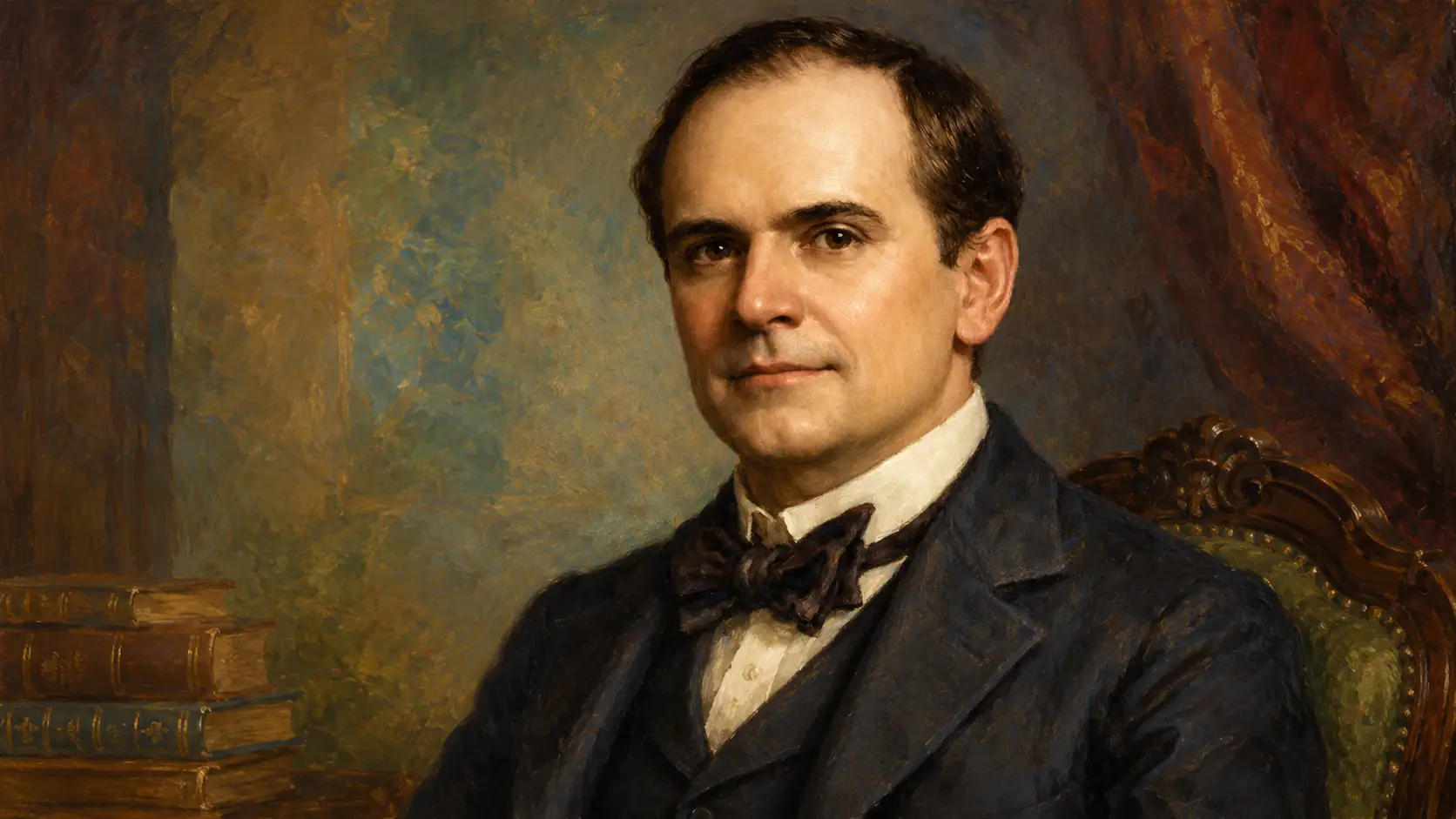
William Walker Atkinson (1862–1932), American attorney and New Thought pioneer who coined the phrase Law of Attraction.
This is not, on its own, an unusual story in the history of ideas. Originators are routinely obscured by popularizers, and Atkinson compounded the problem himself through an extreme commitment to pseudonymous writing that effectively scattered his legacy across at least five distinct pen names and more than a hundred books on subjects ranging from thought vibration to yoga philosophy to Hermetic occultism. He was, depending on which byline you encountered, Yogi Ramacharaka, Theron Q. Dumont, Magus Incognito, Swami Bhakta Vishita, and almost certainly the “Three Initiates” who published The Kybalion in 1908 — still one of the most widely read esoteric texts in the world. He was, under all these names and under his own, one person: a Baltimore-born lawyer who suffered a complete breakdown in his mid-thirties, recovered through New Thought principles, and spent the rest of his life trying to systematize and spread what he believed had saved him.
Understanding Atkinson properly requires holding that double image in view simultaneously: the systematizer who gave the Law of Attraction its name and provided its earliest formal framework, and the restless, often self-concealing writer whose breadth of output meant his specific contributions kept disappearing into the noise of his own productivity. This guide attempts to hold both images steady and explain why the man behind them deserves more direct historical attention than he typically receives.
Early Life and the Collapse That Changed Everything
William Walker Atkinson was born on December 5, 1862, in Baltimore, Maryland, the son of William and Emma Atkinson. His father and grandfather both ran grocery stores, and Atkinson worked in the family business as a teenager before pursuing a more ambitious path through law. By 1882 he was building a dual career as both merchant and attorney, and in 1894 he was admitted to the Bar of Pennsylvania — a conventional middle-class success story, measured by the standards of Gilded Age America, in which a man of modest background established himself through professional achievement and steady accumulation.
What makes Atkinson’s biography interesting is not that career but its collapse. By his early thirties, the combined demands of law practice and business had produced a breakdown serious enough to close both. Contemporary sources describe a complete physical and mental failure, compounded by financial disaster — not a brief episode of overwork but a genuine incapacity that forced a fundamental recalibration of how he understood the relationship between mental state and physical condition. It was in this period that he encountered New Thought teachings, particularly the work circulating through the late-nineteenth-century mental-science and Divine Science communities, and attributed his recovery directly to the application of their principles.
This origin story matters because it was not decorative in his subsequent writing. Atkinson did not become a New Thought author because he found it intellectually interesting or commercially promising (though it became both). He became one because, by his own account, New Thought had given him back his functioning life. That experiential foundation gave his work a quality noticeably different from writers who approached the same material from purely theoretical or theological directions: he wrote as someone testing a system he had already stress-tested on himself, and his readers felt that urgency.
By the early 1890s, Chicago had emerged as the center of American New Thought activity, largely through the work of Emma Curtis Hopkins, who ran a theological seminary there that trained many of the movement’s next generation of teachers. Atkinson moved to Chicago and moved quickly — by 1900 he was associate editor of Suggestion, the leading New Thought journal; by 1901 he had assumed editorship of New Thought magazine, a post he held until 1905; and by the early 1900s he had founded his own Atkinson School of Mental Science and was publishing books at a rate that would eventually exceed a hundred volumes across his lifetime.
William Walker Atkinson and the New Thought Movement
New Thought, by the time Atkinson arrived in Chicago, was already a complex and loosely organized movement with competing factions, terminological disagreements, and an institutional structure ranging from formal denominations (Christian Science, Unity, Divine Science) to informal study circles and magazine subscription communities. What it shared across its variations was a core premise Phineas Quimby had set in motion in the mid-nineteenth century: that mental states causally influence physical and material conditions, and that a trained and disciplined mind can therefore produce outcomes that seem to conventional thinking like luck, coincidence, or miracle.
Atkinson’s specific role in this movement was less that of a theological innovator than of a systematizer and popularizer of extraordinary energy and range. Where figures like Hopkins or Charles Fillmore built institutions, Atkinson built a writing operation. He edited three major New Thought periodicals across his career — Suggestion, New Thought, and Advanced Thought — and used each as a vehicle not just for New Thought broadly but for a specific, practically oriented version of it that emphasized observable mental mechanisms over doctrinal claims. He was past president of the International New Thought Alliance and later, in a 1916 article, publicly criticized that organization’s growing institutionalization, arguing for a more individualist approach to metaphysical practice. The combination of active organizational involvement and principled resistance to that same organization’s orthodoxies is very characteristic of how Atkinson navigated the movement throughout his career: inside the tent, but never fully captured by it.
His editorial work deserves particular attention as a form of influence that operates differently from book-writing. A magazine editor shapes the conversation of an entire field — which ideas get prominence, which writers get audiences, which debates get framed as important. Atkinson’s nearly two decades of sustained editorial presence in the three major New Thought periodicals of his era meant that his particular orientation toward practical mental science, thought vibration, and personal development effectively set the conversational agenda for the movement’s most active readership during the period when those ideas were still being formed. This is a harder kind of influence to trace than book sales, but arguably more consequential.
Did William Walker Atkinson Coin the Phrase “Law of Attraction”?
The short answer, supported by the historical record currently available, is yes — but the full answer requires some precision about what “coined” means in this context.
The phrase “Law of Attraction” appears in the title of Atkinson’s 1906 book Thought Vibration, or the Law of Attraction in the Thought World and is used throughout the text to describe the principle that thought vibrations of a given quality attract corresponding conditions, people, and circumstances. This is the earliest known use of the specific phrase as a named, defined law within what we now call manifestation philosophy, and it is what scholars and researchers consistently point to when tracing the phrase’s origin. Atkinson himself was clear about what he meant: the universe operates under one great Law, and within that Law, the mental dimension operates by attraction — like drawing like, across the vibratory medium of thought.
What Atkinson was not doing was inventing the underlying concept from nothing. The idea that mental states influence material conditions had been developed across decades of New Thought writing before 1906; Helena Blavatsky and the Theosophical tradition had discussed vibrational correspondence; and Transcendentalist writers including Emerson had laid philosophical groundwork for a universe in which mind and matter are not categorically separate. Atkinson synthesized, named, and systematized these existing currents — a contribution that should not be understated simply because it built on prior work.
A further precision: the phrase “Law of Attraction” in late-nineteenth-century scientific writing referred to gravitational and electromagnetic attraction between physical bodies — not mental phenomena. Atkinson’s move was to borrow that scientific-sounding language and apply it explicitly to thought, which both gave the concept the credibility of physical law and placed it in conversation with the era’s fascination with newly discovered invisible forces like electromagnetism and radio waves. The rhetorical strategy was deliberate and effective, and it is a significant part of why his framing stuck while other, less precisely named formulations from the same period did not.
Every thought you think sets in motion invisible forces which in time materialize into facts, things, and conditions in your life.
— William Walker Atkinson, Thought Vibration
This framing — thought as a force that materializes — is precisely the argument that runs unbroken from Atkinson’s 1906 book through Wattles’s Science of Getting Rich in 1910, through Napoleon Hill’s Think and Grow Rich in 1937, and through Rhonda Byrne’s The Secret in 2006. It is a straight intellectual lineage, and it starts here.
William Walker Atkinson’s Core Philosophy
Atkinson’s philosophy, developed across a hundred books under multiple names, is more coherent and more demanding than its reputation as simple positive thinking suggests. Several interconnected ideas form its core.
Thought Vibration and Mental Causation. Atkinson’s fundamental claim is that thoughts are not merely private events but actual forces operating in a vibrational medium. He argued that the brain is the only instrument capable of registering thought-waves, as he called them, and that thoughts operating at certain frequencies inevitably attract matching conditions in the external world — people, circumstances, opportunities, and obstacles — the way a tuning fork causes a matching fork to resonate across a room. This is not a metaphor for him; it is a description of what he understood to be an actual causal mechanism, operating as reliably as physical gravity.
Mental Discipline and the Will. Where much popular Law of Attraction content treats the mechanism as something that operates automatically once a person holds the right thought, Atkinson was considerably more demanding about the role of sustained mental effort. He devoted entire books (most of his Theron Q. Dumont series) to the training of willpower, concentration, and mental control, insisting that casual optimism accomplishes nothing and that the specific discipline of holding a clear mental image against the mind’s own resistance was the actual work the system required. This is a harder and more accurate description of what his system asks for than most later presentations of similar ideas.
The Subconscious as Partner. Atkinson was among the earliest popular writers to systematically distinguish between conscious and subconscious mental activity, arguing that impressions registered at the conscious level must be accepted and acted upon by the subconscious to produce material effects. This is essentially the same claim Neville Goddard would later make about the requirement that ideas be felt rather than merely thought, and that Joseph Murphy would build an entire career around. Atkinson stated it first, in more mechanical and less mystical language, but the underlying model is recognizably the same.
Habit, Character, and Growth. Atkinson refused to limit his system to the acquisition of external goods. His books on character development, personal magnetism, and practical psychology consistently return to the theme that the ultimate target of mental discipline is not a changed circumstance but a changed person — someone whose habitual mental states have been brought into alignment with the conditions they want to live in, rather than someone who has performed a mental technique and is waiting for results. This emphasis on character formation as the core work, with external results as a natural consequence, is a meaningfully different orientation from the more acquisition-focused version of the Law of Attraction that later became dominant.
The man who sends out positive thoughts of courage, power, faith, and hope influences his environment and others with whom he comes in contact, and tends to awaken similar vibrations in them.
— William Walker Atkinson
Major Books and Writings
Atkinson’s output was so large that cataloguing it fully is a project for specialists. But several works stand out for their historical significance and their continued influence.
Thought Vibration, or the Law of Attraction in the Thought World (1906) is the founding text of what would eventually become the modern Law of Attraction genre. It is not a long book, and its central argument is stated plainly in the first chapter: thought operates as vibratory energy that attracts similar conditions. What makes it historically significant is the combination of the specific phrase “Law of Attraction” with a systematic, mechanism-focused account of how the law operates — not through divine will or positive feelings alone, but through a described causal process that a reader can apply deliberately. Every major manifestation book published since owes something to this framing, whether its author knew it or not.
Practical Mental Influence (1908) extends the same framework into interpersonal dynamics, arguing that thought vibrations operate not just on impersonal circumstance but on other people — that a person trained in mental concentration can project influence, attract cooperation, and repel hostility through the quality of their mental states. This is the book most responsible for the “personal magnetism” vocabulary that runs through early twentieth-century success literature and eventually into modern leadership and charisma content.
The Secret of Success (1908) is arguably Atkinson’s clearest practical statement of the entire system: desire, will, concentrated thought, and decisive action working as a single integrated mechanism. Its brevity and directness make it the entry point often recommended to new readers, though its historical significance is slightly overshadowed by Thought Vibration’s terminological priority.
Mind Power: The Secret of Mental Magic (1912) represents Atkinson at his most systematic, pulling together his various threads — vibration, will, subconscious impression, personal magnetism — into a single unified framework. It is the book most useful to scholars wanting to understand how his ideas form a coherent whole rather than a collection of loosely related techniques.
The Kybalion (1908), published under the name “Three Initiates,” deserves separate treatment because its relationship to the rest of his work is often misunderstood. Scholarly consensus, established by writers including Mitch Horowitz and Philip Deslippe (who wrote the introduction to the 2011 Tarcher/Penguin definitive edition), and supported by Atkinson’s own 1912 acknowledgment of sole authorship in Who’s Who in America, treats the book as Atkinson’s. Deslippe’s introduction establishes authorship through stylistic analysis, shared publishing infrastructure, and documentary evidence, and is the most thorough scholarly treatment of the question available. The book presents seven Hermetic principles — mentalism, correspondence, vibration, polarity, rhythm, cause and effect, and gender — framed as ancient wisdom from Hermes Trismegistus. Scholars are agreed that the text is far more indebted to early twentieth-century New Thought than to any authentic ancient Hermetic tradition; what it represents is Atkinson translating his core New Thought ideas into an esoteric register that gave them an aura of ancient authority. The Kybalion has never been out of print since 1908 and remains one of the most widely read esoteric texts in the world — a remarkable legacy for a book most of whose readers do not know who actually wrote it.
The Universe is governed by Law—one great Law. Its manifestations are multiform, but viewed from the Ultimate, there is but one Law. We are familiar with some of its manifestations, but are almost totally ignorant of certain others.
— William Walker Atkinson, Thought Vibration
Influence on Modern Manifestation Philosophy
Atkinson’s influence on modern manifestation philosophy is both direct and structural, and the two kinds of influence have operated through very different channels.
The direct influence runs through the writers who read him, built on him, and occasionally credited him. Wallace D. Wattles published The Science of Getting Rich four years after Thought Vibration appeared and was actively writing in the same New Thought publishing ecosystem during the period when Atkinson’s editorial presence in the movement’s magazines was at its peak. Wattles never uses the phrase “Law of Attraction” — his own term is “Creative Substance” and “the Certain Way” — but the underlying architecture of thought-as-cause, gratitude-as-mechanism, and action-as-completion is recognizably continuous with Atkinson’s framework. Napoleon Hill, writing Think and Grow Rich in 1937, builds his “burning desire” and “auto-suggestion” concepts on foundations Atkinson had laid; the specific claim that thought impresses itself on the subconscious through repetition and intensity, and that the subconscious then influences external circumstances, is Atkinson’s model stated in Hill’s more secular, achievement-focused language.
The structural influence is harder to see but more pervasive. Atkinson gave the entire field a vocabulary — “Law of Attraction,” “thought vibration,” “mental influence,” “personal magnetism” — that subsequent writers inherited whether they had read him or not, because his magazine work had made that vocabulary the default language of New Thought before most of his successors arrived. By the time Rhonda Byrne’s The Secret popularized the phrase globally in 2006, it had been in continuous circulation in manifestation and self-help literature for a full century, traveling through enough intermediary sources that its origin point was genuinely obscure to most people using it. Byrne’s film and book named Wattles as a direct source; Atkinson, who named the concept Byrne’s entire project is built around, went unmentioned.
There is also an indirect channel worth noting: The Kybalion’s seven Hermetic principles, particularly mentalism (“All is Mind”) and vibration (“Nothing rests; everything moves; everything vibrates”), have circulated continuously through occult and New Age communities since 1908 and appear in countless books and teachings that present them as ancient wisdom without tracing them to Atkinson. The principle of vibration in particular — that different mental and emotional states operate at different frequencies and attract corresponding conditions — is now so embedded in New Age and manifestation content that it functions as a background assumption rather than an idea with a traceable origin. That origin is, almost certainly, Atkinson.
Common Misunderstandings About William Walker Atkinson
Several persistent misconceptions distort how Atkinson is remembered, even among readers who are familiar with his name.
He was not primarily or only a Law of Attraction writer. The phrase “Law of Attraction” appears in the title of one book. His output across a lifetime includes systematic treatments of yoga, Hermetic philosophy, practical psychology, Hindu philosophy, personal magnetism, occult practice, character development, and mental healing. Filing him under “Law of Attraction writer” is like calling a physician who once published a paper on a specific diagnostic technique a specialist in that technique alone.
He did not teach magical thinking. Atkinson’s system consistently requires disciplined, sustained, deliberate mental effort. His books on willpower, concentration, and mental control are more demanding than most contemporary self-help content, not less. The popular image of Law of Attraction as a passive “think happy thoughts and receive” mechanism is essentially the opposite of what Atkinson actually wrote.
His pseudonymous works are not separate bodies of work. The conventional reading of Atkinson treats his books under his own name separately from the Yogi Ramacharaka, Theron Q. Dumont, and “Three Initiates” materials. Scholars now largely treat them as a single, sprawling system by one writer exploring different aspects of a unified worldview from multiple angles — Western mental science, Eastern yogic philosophy, and Hermetic occultism all functioning as different entry points into the same underlying conviction that mind is primary and causally powerful.
His obscurity is not evidence of limited influence. Atkinson’s personal secrecy, his preference for pseudonyms, and the sheer volume of his output combined to make him difficult to track across a career that was, by any measure, enormously influential. The fact that most modern readers of manifestation content have never heard of him is a story about how attribution works in popular culture, not about how much his ideas shaped the field they are reading.
Criticisms, Debates, and Historical Perspective
A balanced account of Atkinson’s work requires engaging with the criticisms that have been directed at both his methods and his intellectual honesty.
The most substantive criticism concerns The Kybalion’s claim to ancient Hermetic authority. Scholars of actual Hermetic philosophy, including Brian Copenhaver and Wouter Hanegraaff, have noted that the text is far more continuous with early twentieth-century New Thought than with the Corpus Hermeticum or any other genuine ancient Hermetic source. The seven principles it presents differ significantly from classical Hermetic texts in emphasis, vocabulary, and philosophical framework. This does not necessarily undermine the book’s utility as a spiritual or philosophical text, but it does mean that readers who approach it as a transmission of ancient wisdom are receiving something manufactured much more recently — a marketing frame, not a historical lineage, however effective that frame has been.
A related debate concerns Atkinson’s Yogi Ramacharaka series, which presented Indian yogic philosophy to Western audiences under an Indian name. The books were read by many as the work of an actual Indian teacher, and were later appropriated by Western spiritual entrepreneurs who sold copies autographed as if they had written them — a chain of appropriation that reflects poorly on the initial disguise, whatever Atkinson’s original intentions were. Whether he adopted the Ramacharaka persona to protect his legal career (a common theory, since he was still technically a practicing attorney) or for marketing reasons, or because he believed it would give the material more credibility with the target audience, is not definitively documented.
The broader criticism of mental science — that it proposes a causal mechanism between thought and material outcome for which no credible scientific evidence has been established — applies to Atkinson’s work as directly as to any other New Thought writing. He was a man of his era: the late nineteenth and early twentieth centuries were a period of genuine excitement about invisible forces (radio waves, electromagnetism, X-rays), and his thought-vibration framework was a reasonable, if not scientifically validated, attempt to place mental causation within the same conceptual world as those newly discovered physical phenomena. Read a century later, the framework’s metaphors have aged unevenly: the radio-wave analogy is no longer persuasive to scientifically literate readers, even if the practical discipline he was describing — training attention, managing mental states, directing will — has more support from contemporary psychology than the metaphysical packaging would suggest.
Lasting Legacy
Atkinson died on November 22, 1932, in Los Angeles, California, at the age of sixty-nine. He had spent his final decade in declining health but continued writing almost to the end — his posthumous output includes material compiled from writings completed before his death. He left behind no church, no organization capable of carrying his specific name forward, and no institutional successor. What he left was a body of work — over a hundred books under his own name and several pseudonyms — that has never, in more than a century, gone entirely out of print.
That durability is not accidental. Unlike teachers whose work requires an institutional framework to survive them, Atkinson’s books are self-contained and public-domain accessible, which means they circulate freely and permanently regardless of what any organization does or does not do to preserve them. The Kybalion alone has sold millions of copies since 1908 and received a major scholarly edition in 2011, introducing it to a new generation of readers as a named Atkinson work rather than a mysterious ancient text. His Yogi Ramacharaka series continues to reach audiences interested in yogic breathing and Hindu philosophy who often have no idea they are reading a Baltimore lawyer’s synthesis from a century ago. And Thought Vibration, for readers who trace their interest in the Law of Attraction back to its documented sources, remains the primary document — the place where the phrase was coined, defined, and given its first systematic treatment.
Learn to keep your mental house in order. Allow only those thoughts, feelings and mental images to dwell within it which you wish to see materialized in the outer world.
— William Walker Atkinson
Why William Walker Atkinson Still Matters Today
The case for reading Atkinson today is not primarily historical, though the historical case is strong. It is that his system, read in its original form rather than through the many layers of popularization that have softened it, is more demanding, more precise, and more practically useful than most of its descendants.
The specific thing that has been lost in transmission is Atkinson’s emphasis on mental discipline as the operative work, not mental attitude as a passive background condition. Most Law of Attraction content available today asks readers to feel good, visualize desired outcomes, and trust that results will follow. Atkinson’s system asks readers to train concentration, build willpower, practice sustained mental focus against the mind’s own resistance, manage thought quality as an ongoing discipline rather than a periodic performance, and take decisive physical action when opportunity presents itself. This is a meaningful distinction, and it is one that explains why readers who find the passive version of the Law of Attraction produces inconsistent results often find Atkinson’s original formulation more tractable — not because it promises more, but because it specifies exactly what the work actually requires.
There is also something worth noting in the sheer range of his intellectual interests. Atkinson moved freely between Western mental science, Eastern yogic philosophy, Hermetic occultism, practical psychology, and personal development, treating all of them as different approaches to the same underlying question: how does a human mind actually work, and how can it be trained to work better? That synthetic ambition — to find the common mechanism beneath apparently different traditions — is exactly what many contemporary readers are attempting in their own eclectic ways, and Atkinson’s work, once properly attributed and contextualized, turns out to be a remarkably early and comprehensive attempt at exactly that synthesis.
Curator’s Perspective
Of all the figures I have spent time with in this field, Atkinson is the one whose actual work most consistently surprises readers who come expecting something simpler. The phrase “Law of Attraction” has been so thoroughly domesticated into the language of passive wish-fulfillment that encountering the man who named it — writing about willpower training, mental concentration, and the sustained discipline of attention against one’s own habitual resistance — produces a genuine cognitive dissonance. He sounds, in places, more like a cognitive behavioral therapist than a manifestation guru. That is not a coincidence: what he was describing, in the language available to him in 1906, is closer to what contemporary psychology understands about the relationship between habitual thought patterns and behavior than the popular version of his most famous idea would suggest.
What I find most historically interesting about Atkinson is the pseudonym problem, not as a biographical curiosity but as a clue to how his ideas actually spread. By publishing essentially the same worldview under five different names aimed at five different audiences — Western seekers interested in mental science, yoga enthusiasts, Hermetic occultists, practical success-seekers, and students of personal magnetism — Atkinson effectively inoculated the twentieth century with a single set of ideas without any single channel being large enough to crowd out the others. When one tradition went quiet, another carried the load. The result is that his ideas are woven through modern Western spiritual culture at every level, and their source is almost perfectly obscured — not through neglect but through the very mechanism of distribution he designed. That is a peculiar kind of genius, and it deserves more direct recognition than it has received.
Explore More Law of Attraction Quotes
Many readers first encounter William Walker Atkinson through his quotations on thought, mental discipline, and the laws of attraction. For a broader collection of inspirational and historical Law of Attraction quotations from influential thinkers and authors, explore our Law of Attraction Quotes collection.
Key William Walker Atkinson Principles at a Glance
William Walker Atkinson coined the phrase “Law of Attraction” in 1906 and spent the next three decades building one of the most comprehensive systems of practical mental philosophy in New Thought history — under his own name and at least five pseudonyms. His core claim — that thought operates as a vibrational force that attracts matching conditions — is the direct ancestor of every Law of Attraction book published since.
- Thought vibration — thoughts operate as actual vibrational forces that attract corresponding people, conditions, and circumstances
- Mental discipline over passive optimism — sustained, trained concentration is the operative work, not a generalized positive attitude
- Subconscious impression — conscious ideas must be accepted by the subconscious, through repetition and feeling, to produce material effects
- Character as the real lever — the target of mental development is a changed person, not merely a changed circumstance
- Personal magnetism — trained mental states project influence that shapes interpersonal dynamics as well as impersonal conditions
Law of Attraction Central has been an independent resource for the serious study of manifestation philosophy, New Thought history, and consciousness research since 2012. Our content is built from primary sources, verified scholarship, and more than a decade of independent research.
Curated by Don Allen, Founder of Law of Attraction Central
Since founding the site in 2012, Don has spent more than a decade researching the history of manifestation philosophy, New Thought literature, and the development of modern Law of Attraction teachings, with a particular focus on presenting historical figures like William Walker Atkinson accurately and in proper context.
This page will next be reviewed in June 2027.