Wallace D. Wattles: The Life, Teachings, and Legacy of the Man Who Inspired The Secret
In late 2004, a television producer in Melbourne, reeling from her father’s death and the collapse of her career, was handed a slim, decades-old book by her daughter. The book was The Science of Getting Rich, written in 1910 by a largely forgotten Indiana writer named Wallace D. Wattles. That producer was Rhonda Byrne, and the book became the seed of The Secret — the documentary and bestseller that introduced the phrase “Law of Attraction” to millions of people who had never heard of New Thought, Wattles, or the strange, quietly radical little book that started it all.
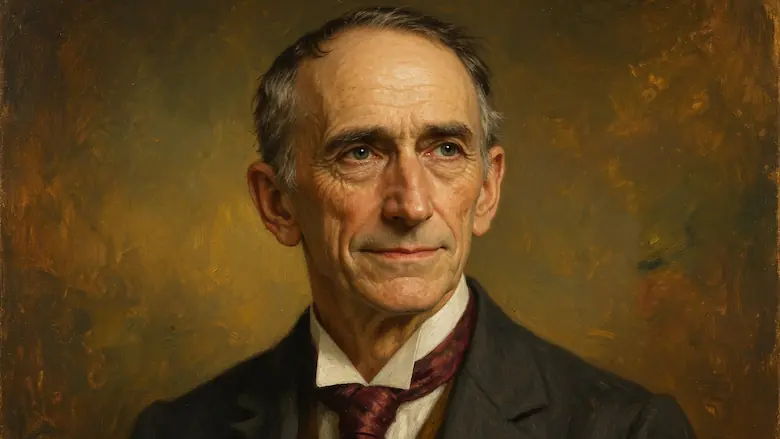
Wallace D. Wattles (1860–1911), American New Thought writer and author of The Science of Getting Rich.
Wattles himself never saw any of this. He died of tuberculosis in February 1911, one year after The Science of Getting Rich was published, having spent most of his life in poverty, obscurity, and repeated political defeat as a Socialist candidate in rural Indiana. He is, by any conventional measure, one of the least personally documented figures in the entire history of manifestation philosophy — and yet his short, plainly written book is arguably the single most consequential text in that history, having shaped Napoleon Hill, Charles Haanel, Bob Proctor, and, through Byrne, the entire twenty-first-century revival of Law of Attraction thinking.
This guide traces who Wattles actually was, what he taught and why it differed from the New Thought mainstream around him, and how a self-described Christian Socialist farmhand’s book about wealth ended up, a century later, as the unacknowledged source code for one of the bestselling self-help phenomena in publishing history.
Early Life and Historical Context
Wallace Delois Wattles was born in 1860 in Illinois, the only child recorded as living with his parents on a farm in Nunda Township, McHenry County, according to the 1880 census. His father worked as a gardener; his mother kept the house. There is no record of formal education beyond what was typical for a rural Midwestern farm family of the period, and Wattles himself, by his daughter Florence’s account, spent much of his early adulthood excluded from the world of commerce and unable to gain financial traction despite years of effort.
The turning point came in the winter of 1896, when Wattles, then thirty-six, attended a meeting addressed by George Davis Herron, a Congregational minister and prominent voice of the Christian Socialist movement then spreading through the American Midwest. Herron preached a fusion of socialist economics and applied Christianity — the conviction that the teachings of Christ, properly understood, demanded structural concern for material poverty, not merely private piety. The encounter reoriented Wattles’s thinking permanently. He went on to study Hegel, Emerson, and a range of monistic and idealist philosophy, and recommended this same reading to his own followers as the foundation for understanding what he called “the monistic theory of the cosmos” — the idea that all reality, mental and material, is a single underlying substance rather than two separate categories of mind and matter.
This dual inheritance — Christian Socialism on one side, German idealist philosophy on the other — is what makes Wattles genuinely unusual among New Thought writers, and it is largely absent from how he is remembered today. He ran twice for public office as a Socialist Party candidate, for Indiana’s Eighth Congressional District in 1908 and for county prosecuting attorney in 1910, losing both races. His daughter Florence remained active in Socialist Party politics for years after his death. None of this fits comfortably with the version of Wattles that later marketing built around The Science of Getting Rich — a version that strips out the socialism entirely and leaves only the wealth-attraction mechanics. The man who wrote the most influential prosperity book in New Thought history was, by conviction and by ballot, a socialist who believed the same spiritual principle that could make one person rich was meant, ultimately, to lift everyone.
Wallace D. Wattles and the New Thought Movement
New Thought, by the time Wattles encountered it, was already a loosely organized but rapidly spreading American religious and philosophical current, tracing its roots to Phineas Quimby’s mid-nineteenth-century experiments in mental healing. Quimby had observed that a patient’s beliefs about illness seemed to shape the illness itself, and out of that observation grew a broader conviction, developed by figures like Mary Baker Eddy and later popularized more loosely across many independent teachers and churches, that mental states exert a causal influence on physical and material conditions generally — not just health.
Wattles came to this movement through Chicago, where he encountered prominent New Thought figures including Emma Curtis Hopkins, often called the “teacher of teachers” for her role in training many of the movement’s next-generation leaders, and William Walker Atkinson, who would later write the 1906 book that first popularized the actual phrase “Law of Attraction.” Wattles absorbed the central New Thought premise — that mind operates causally on matter — but he applied it somewhere New Thought had mostly not yet gone in a sustained, systematic way: directly and explicitly to the accumulation of money.
This is Wattles’s specific contribution to the movement, and it is easy to miss because it now seems so obvious. Quimby and his direct successors were focused on health. Hopkins and the wider New Thought church movement were focused on spiritual development and divine selfhood. Wattles took the same underlying metaphysics and asked a much more practical question: if mind operates causally on the body, why would it not operate causally on a bank account? He titled his books with the word “science” deliberately, borrowing the credibility of the era’s most prestigious New Thought offshoot, Christian Science, while presenting a secular, mechanism-focused account rather than an explicitly religious one. The result was a New Thought text that read less like a sermon and more like an engineering manual for the inner life — a tone that later writers from Hill to Byrne would all, in their own ways, imitate.
The Core Philosophy of Wallace D. Wattles
Wattles opens The Science of Getting Rich with a claim stated as plainly as a geometry axiom: there is a thinking stuff from which all things are made, and which, in its original state, permeates, penetrates, and fills the interspaces of the universe.
He calls this Formless Substance, or Creative Substance — a single responsive medium, rather than inert matter, that takes shape according to the thought impressed upon it. This is the metaphysical foundation everything else in his system rests on, and it is worth taking seriously on its own terms before assessing what readers actually did with it.
From that foundation, several interlocking ideas do the practical work of his system.
Thinking in a Certain Way. Wattles was insistent that wanting something and thinking about it are not the same action. “Certain Way” thinking means holding a clear, specific, uninterrupted mental image of the outcome desired, while actively excluding contradictory images of lack or failure. This is not casual optimism; it is closer to a discipline of mental hygiene, requiring the thinker to notice and discard discouraging thoughts as they arise rather than entertaining them.
The Creative Plane versus the Competitive Plane. This distinction is arguably Wattles’s single most original contribution. Most wealth-seeking behavior, in his account, operates on the competitive plane — the assumption that the total supply of wealth is fixed, so that one person’s gain is necessarily another’s loss. Wattles rejected this premise outright. Operating from the creative plane means generating value that did not exist before, rather than redistributing a fixed pool by out-competing someone else for it. This is also the basis of his repeated insistence that getting rich by his method requires no one else to become poorer — a claim that sits, not coincidentally, very close to his Christian Socialist conviction that true prosperity could not be built on anyone’s deprivation.
Gratitude as Mechanism, Not Sentiment. Wattles treats gratitude as a functional component of the system rather than a pleasant emotional add-on. Gratitude draws the mind into closer touch with the source from which the blessings come,
he wrote — meaning gratitude is what keeps attention oriented toward supply and continuity rather than drifting back toward scarcity and lack. Skipping gratitude, in his account, is not a minor omission; it breaks the connection the entire mechanism depends on.
Purposeful Action. Wattles was unusually blunt, for a metaphysical writer, about the limits of thought alone. By thought the thing you want is brought to you; by action you receive it,
he wrote, drawing a hard line between the inner work of assumption and the outer work of seizing whatever specific opportunity appears in front of a person, today, in their current circumstances — not some imagined future opportunity once conditions improve.
Wealth as Expansion, Not Accumulation. Wattles framed the pursuit of wealth as inseparable from the pursuit of a fuller life. “The purpose of life for man is growth,” he wrote, treating the desire for more — more money, more capability, more experience — not as greed but as the same drive that makes a tree reach toward light. This reframing is part of what let him hold prosperity teaching and socialist conviction simultaneously without apparent contradiction: growth, in his account, was a universal life-principle rather than a private competitive advantage.
The Science of Getting Rich
The Science of Getting Rich was published in 1910 by Elizabeth Towne, the Massachusetts-based editor of the New Thought magazine Nautilus, who had carried Wattles’s writing in nearly every issue for years and who would remain his primary publisher for the rest of his short career. The book runs seventeen short, plainly structured chapters, and its brevity is part of its enduring appeal — it states its claims directly, with almost no anecdote or padding, and reads more like a manual than a memoir.
Its historical significance is twofold. First, it preceded and arguably set the template for the two books most often credited with founding the modern success-literature genre: Charles Haanel’s The Master Key System (1912) and Napoleon Hill’s Think and Grow Rich (1937), both of which cover strikingly similar ground — specific desire, sustained mental conviction, decisive action — without ever fully crediting Wattles as a source. Hill’s book in particular, published twenty-seven years after Wattles’s, expands the same core argument with extensive case studies of wealthy industrialists Wattles never had access to, but the underlying metaphysical claim is recognizably the same one Wattles stated first and more concisely.
Second, and more directly, the book is the specific, documented origin point of the entire twenty-first-century Law of Attraction revival. Rhonda Byrne has stated directly that reading The Science of Getting Rich in 2004 was what introduced her to the foundational idea behind The Secret. This is a more concrete and traceable line of influence than most historical claims of this kind allow for — not an analyst’s inference about shared themes, but the author’s own account of the specific book that started it.
The book’s continued relevance owes something to what it does not do. It does not promise wealth without effort, and it does not flatter the reader with stories of the author’s own success; Wattles was, by every account, modestly successful at best during his lifetime. What it offers instead is a clean, complete causal model — substance, thought, gratitude, action — stated with enough precision that a reader can actually test it against their own life, which is precisely what generations of readers, including Byrne, report having done.
How Wallace D. Wattles Influenced Modern Law of Attraction Thought
Wattles’s influence on modern manifestation thought runs through at least three distinct channels, each of which simplified or modified his original system in a different direction.
The first channel runs through the early success-literature tradition itself. Napoleon Hill’s Think and Grow Rich retains Wattles’s core insistence on a clearly defined desire and unwavering mental conviction, but largely drops the explicit metaphysics of a single Creative Substance in favor of a more secular, achievement-oriented framing built around studying successful individuals. Charles Haanel’s The Master Key System, published closer in time to Wattles, keeps more of the metaphysical architecture but organizes it into a systematic weekly curriculum that Wattles’s looser, more essay-like chapters never attempted. Both books outsold Wattles during the twentieth century, which is part of why his name became less familiar even as his ideas became more pervasive.
The second channel runs through later motivational speakers who studied Wattles directly rather than absorbing him secondhand. Bob Proctor, who appeared prominently in The Secret and built a decades-long career teaching prosperity principles, studied Wattles’s work closely and has cited him as a formative influence — a direct teacher-to-teacher line that more diffuse cultural influence claims usually cannot establish.
The third and most consequential channel is the one already described: Byrne’s direct encounter with the book, which led to The Secret, which in turn introduced an entire generation of readers to the phrase “Law of Attraction” — a term Wattles himself never used, since it was William Walker Atkinson, not Wattles, who coined it in his own 1906 book. This is a detail worth pausing on: the man whose book inspired the modern Law of Attraction movement was not the man who named it. Byrne’s film and book absorbed Atkinson’s terminology and Wattles’s substance, and the resulting blend is what most people today mean when they say “the Law of Attraction” — even though the phrase and the underlying mechanics come from two different authors who likely never met.
What was lost in this chain of transmission is, again, the socialism and the gratitude-as-mechanism precision. Each successive simplification moved further from Wattles’s insistence that creative-plane wealth requires no one’s loss, and further from his treatment of gratitude as a structural requirement rather than an optional mood. What survived, and ultimately reached the widest audience, was the more easily marketable core: think clearly, expect abundance, take action, and the structure of the universe responds accordingly.
Common Misunderstandings About Wallace D. Wattles
Because The Science of Getting Rich is short, frequently excerpted, and often read in isolation from Wattles’s broader work and biography, several persistent misreadings have taken hold.
Wattles did not teach passive wishing. His repeated insistence that “by thought the thing you want is brought to you; by action you receive it” makes the action component non-negotiable. Thought organizes the pathway; it does not substitute for walking it.
Wattles did not advocate greed. His framing of wealth as growth rather than accumulation, and his explicit operation on what he called the creative rather than competitive plane, was a direct argument against wealth pursued at others’ expense. This is reinforced by his own political commitments: a man running for office as a Socialist candidate while writing a wealth-attraction manual is not advocating greed by any coherent reading of his actual biography.
Wattles did not teach wealth at the expense of others. This follows directly from the creative-plane distinction above. His system explicitly depends on value creation rather than competitive displacement; a reading of The Science of Getting Rich that treats it as a justification for zero-sum thinking has inverted its central argument.
His philosophy was not purely mental. The most common popular flattening of Wattles strips out everything except positive thinking. But his system, read in full, requires gratitude as an active practice and decisive, opportunity-specific action as a non-optional final stage — making it considerably more demanding than the “just think positive” caricature that later popularizers sometimes reduced it to.
Major Works Beyond The Science of Getting Rich
Wattles conceived The Science of Getting Rich as one panel of a triptych, publishing companion volumes on health and personal greatness in matching bindings, and the other two books reveal dimensions of his thinking that the wealth book alone does not.
The Science of Being Well (1910) applies the same Creative Substance framework to physical health, arguing that disease originates in disordered thought and faulty function rather than external causation alone. It includes extensive practical material on diet, fasting, and eating only when hunger is genuinely earned through activity — material that has aged unevenly; some readers find its attention to mindful eating and rest strikingly ahead of its time, while its more sweeping claims about disease causation reflect the limits of early twentieth-century medical understanding rather than insight that has held up scientifically.
The Science of Being Great (1911), published the same year as his death, is Wattles’s most personal and arguably most ambitious book. Where Getting Rich is mechanically focused on a single outcome, Being Great widens the lens to ask what a fully developed human life actually requires, defining greatness not as fame or achievement but as the conscious unfolding of capability already latent in every person. It leans more heavily on explicit Christian and idealist language than the wealth book does, including direct engagement with the teachings of Jesus read through Wattles’s monistic lens, and it is the clearest written expression of the philosophical synthesis — Christian Socialism plus German idealism — that shaped his entire body of work.
Beyond the trilogy, Wattles wrote shorter, lesser-known works including A New Christ, a pamphlet built from an earlier lecture, and How to Get What You Want, a more compact restatement of his core mechanics. None achieved the reach of the three major books, but they show a writer continuing to refine the same handful of convictions across multiple formats until his death foreclosed further development.
Criticisms, Debates, and Different Interpretations
An honest account of Wattles’s legacy has to include the substantial criticism his work has attracted, both in his own time and since.
The most direct criticism concerns evidentiary grounding. The Science of Getting Rich is frequently described by critics as pseudoscientific, offering no verifiable mechanism by which thought directly alters external financial circumstances, and some reviewers have characterized it as a power-of-positive-thinking text with no proven strategy beneath its confident tone. This criticism applies with even more force to the diet and disease-causation claims in The Science of Being Well, where Wattles’s health theories reflect period-specific, now largely discredited ideas about food, fasting, and illness.
A second, more structural debate concerns the apparent tension between Wattles’s socialism and his wealth teaching. Critics have pointed out that a philosophy promising that anyone can become wealthy through correct thought, if taken at face value, can function to obscure structural and economic barriers that correct thought alone cannot overcome — the same criticism leveled at prosperity philosophy broadly, before and since. Wattles’s own answer, embedded in his creative-plane argument, was that he was describing wealth generated through new value creation rather than wealth redistributed from a fixed pool, which sidesteps but does not fully resolve the tension between universal promise and unequal starting conditions.
A third debate, internal to New Thought scholarship, concerns how directly to read Wattles’s metaphysics. Some interpreters treat Formless Substance as a serious philosophical claim continuous with Hegelian and Emersonian monism; others read it as a rhetorical device borrowed from the prestige of Christian Science, deployed mainly to make a practical self-help program sound more authoritative than a purely secular framing would have allowed. Both readings can be defended from the text, and Wattles himself, who explicitly recommended Hegel and Emerson to readers wanting to go deeper, seems to have intended the metaphysics to be taken seriously rather than as mere packaging — even if later popularizers treated it as exactly that.
Lasting Legacy
Wattles died on February 7, 1911, in Ruskin, Tennessee — a town with its own history as a defunct socialist cooperative colony, a location that fits his political commitments more than mere coincidence would suggest. His body was returned to Elwood, Indiana, for burial; according to his daughter’s account, local businesses closed for two hours during his funeral as a mark of the affection the town held for him, despite his relative lack of national recognition during his lifetime.
For most of the twentieth century, Wattles remained a minor, often-overlooked figure even within New Thought circles, eclipsed by louder and better-marketed successors like Hill. What changed his standing permanently was Byrne’s direct, repeatedly stated acknowledgment of him as the specific origin of The Secret — a credit that sent millions of new readers back to a 1910 book most of them would otherwise never have encountered. That single act of attribution did more for Wattles’s legacy than a century of quiet circulation in New Thought reading lists had managed on its own, and it illustrates something distinctive about how influence accumulates in this field: a teacher can shape an entire later movement while remaining personally almost invisible, waiting on one reader, decades later, to make the connection explicit.
Why Wallace D. Wattles Still Matters Today
Part of the answer is simply precedence: when a reader wants to trace the Law of Attraction back to its specific documented source rather than a vague cultural current, Wattles is the closest thing manifestation philosophy has to a paper trail, with Byrne’s own testimony providing the link most historical influence claims lack.
But precedence alone would not keep a book in print for more than a century. What keeps The Science of Getting Rich readable today is its unusual clarity. Wattles makes a complete, falsifiable causal claim in plain language and then stops, rather than padding the claim with anecdote or appeals to authority. There is no labor from which most people shrink as they do from that of sustained and consecutive thought,
he wrote — a line that reads less like spiritual encouragement and more like an honest warning about how difficult his method actually is to practice, which is a rarer quality in this genre than it should be.
There is also something that feels surprisingly current in his creative-versus-competitive framing. A century before “abundance mindset” became a familiar phrase in business and personal-development writing, Wattles had already built an entire system around the distinction between value creation and zero-sum competition — an idea now treated as a relatively modern insight in entrepreneurship literature, but one Wattles had already worked out, in full, in 1910.
Curator’s Perspective
What strikes me most about Wattles, having spent years tracing this lineage, is how thoroughly the marketing afterlife of his work has erased the man who actually wrote it. The Wattles who shows up in most modern prosperity content is a stripped-down wealth technician — think clearly, expect abundance, get rich. The actual Wattles ran for office as a socialist twice and lost twice, studied Hegel for fun, and believed the same creative power that built a fortune was meant to build a fuller life for everyone, not a private advantage for the thinker alone. I don’t think that contradiction makes him less useful as a teacher; if anything, it makes the gratitude and creative-plane sections of his system harder to skip past as filler, because they were never filler to him. He built his wealth teaching on top of a political conviction most of his modern readers would be surprised to learn he held, and the book is, if anything, more interesting once you know that.
Explore More Law of Attraction Quotes
Many readers first encounter Wallace D. Wattles through his memorable quotations and teachings. For a broader collection of inspirational and historical Law of Attraction quotations from influential authors and thinkers, explore our Law of Attraction Quotes collection.
Key Wallace D. Wattles Principles at a Glance
Wallace D. Wattles taught that a single Creative Substance underlies all matter, and that wealth is generated — not merely earned — through a specific combination of clear thought, structural gratitude, and decisive action on present opportunity. His 1910 book The Science of Getting Rich directly inspired Rhonda Byrne’s The Secret, making him the most concretely documented origin point in the modern Law of Attraction movement.
- Creative Substance — a single responsive substance that takes the shape of the thought impressed upon it
- The Certain Way — holding a clear, specific mental image while excluding contradictory thoughts of lack
- Creative vs. competitive plane — generating new value rather than competing for a fixed supply
- Gratitude as mechanism — a structural practice that keeps attention oriented toward supply, not a sentimental extra
- Purposeful action — thought brings the thing; action is what actually receives it
Law of Attraction Central has been an independent resource for the serious study of manifestation philosophy, New Thought history, and consciousness research since 2012. Our content is built from primary sources, verified scholarship, and more than a decade of independent research.
Curated by Don Allen, Founder of Law of Attraction Central
Since founding the site in 2012, Don has spent more than a decade researching the history of manifestation philosophy, New Thought literature, and the development of modern Law of Attraction teachings, with a particular focus on presenting historical figures like Wallace D. Wattles accurately and in proper context.
This page will next be reviewed in June 2027.